Overview
With the rapid development of the petrochemical industry, especially in recent years, crude oil has become heavier and of poorer quality, while the
demand for light oils such as gasoline and diesel continues to grow, and environmental protection requirements have become increasingly stringent.
Therefore, the selection of residue processing schemes is particularly important. Ebullated bed residue hydrocracking technology boasts technical
advantages including high residue conversion rate, wide feed adaptability, low environmental pollution, and high return on investment, and has been
widely applied. However, as key control equipment in such units, metal seated ball valves are subject to higher design requirements.
Analysis
The main reaction media in the ebullated bed residue hydrocracking process are residue (containing sulfides), hydrogen, and solid catalysts, presenting
a gas-solid-liquid three-phase state. During the reaction, the process destabilizes the residue feedstock, causing unstable substances such as asphaltenes
to easily precipitate from unconverted residue products at high temperatures. Meanwhile, the ebullated bed residue hydrocracking unit experiences
alternating temperatures and pressures during catalyst addition and recovery. Asphaltenes and other substances tend to condense at lower temperatures,
leading to coking in subsequent valves, pipelines, and other components. For metal seated ball valve specifically, asphaltenes may coke in cavities such
as the valve chamber and spring chamber, resulting in failure of elastic components, incomplete valve opening/closing, internal leakage, increased
operating torque, and even complete immobility.
Simultaneous alternating medium temperature and pressure complicate the traditional flange gasket sealing structure, which relies on bolts to provide
sealing torque, as such alternations can cause external valve leakage — a condition that is strictly prohibited. Additionally, the process is characterized
by high temperature, high pressure, hydrogen service, hydrogen sulfide, and catalyst presence. Therefore, the selection of valve materials and design
considerations for valve structure and linear thermal expansion of components are critically important. When the medium contains hydrogen and
hydrogen sulfide, hydrogen atoms penetrate into the metal interior under high temperature and pressure, causing environmental hydrogen
embrittlement, which reduces or even eliminates metal strength. At a certain concentration, hydrogen sulfide induces rapid uniform stress corrosion
cracking in metals.
The catalyst in the medium has a Rockwell hardness of 58.6 HRC. Under high pressure differentials, these hard particles cause erosion and flow
impingement on the valve, damaging components and sealing pairs and leading to internal leakage. As critical control equipment for ebullated bed
residue hydrocracking units, metal seated ball valve must meet bidirectional sealing requirements due to the unique operating conditions.
Valve Design
Based on the above operating conditions, relevant technical specifications, and practical operational issues, the design of a metal seated ball valve for
ebullated bed residue hydrocracking units is illustrated using an 8”-Class 2500 valve as an example.
1. Design Standards
• Valve design, manufacturing, and inspection shall comply with ASME B16.34 Valves — Flanged, Threaded, and Welded Ends
• Face-to-face and end-to-end dimensions shall comply with ASME B16.10 Face-to-Face and End-to-End Dimensions for Valves
• Valve testing shall comply with API 598 Valve Inspection and Testing
• Low-leakage testing shall comply with ISO 15848 Industrial Valves — Measurement, Test and Qualification Procedures for Low-Leakage Classification
• Material selection shall comply with NACE MR0103 Materials Resistant to Sulfide Stress Cracking in Corrosive Petroleum Refining Environments
2. Material Selection
• Body material: Forged high-temperature stainless steels including ASTM A182 Gr. F321/F347/F347H are selected, featuring high strength and
excellent corrosion resistance under high temperature and pressure.
• Ball, seat, and stem materials: Precipitation-hardened high-temperature nickel alloys such as ASTM B637 Inconel 718 are adopted, offering high
strength, good oxidation resistance, stress corrosion cracking resistance, and pitting resistance under severe conditions. Using the same material
for the ball and seat ensures identical thermal expansion under thermal shock and alternating medium temperatures (due to the same coefficient
of thermal expansion), preventing seizure between the ball and seat at high temperatures.
• Packing material: High-purity composite molded expanded graphite is used, with uniform Inconel metal wires embedded in the upper and lower
packing rings. It exhibits excellent extrusion resistance, low friction coefficient, and stable overall performance at high temperatures, satisfying the
valve’s low-leakage requirements.
• Spring material: Precipitation-hardened nickel alloy Inconel 718 is applied, providing superior corrosion resistance, especially favorable toughness
and fatigue strength at elevated temperatures.
3. Structural Design
As mentioned above, ebullated bed residue hydrocracking units feature high temperature, high pressure, gas solid liquid three phase flow, high
hardness catalyst particles in the medium, cyclic alternating temperature and pressure, and a tendency for coking. Therefore, the selection of the
valve structure is of critical importance. For the same design parameters, trunnion mounted ball valves have lower operating torque and are more
economical. However, they demand high coaxiality for the upper and lower bearings, and due to their inherent structural characteristics — a fixed
ball and floating seats — they are prone to seizure under such severe service conditions and have a high maintenance rate. This is confirmed by
the actual performance of metal seated trunnion ball valve in field operation.
Compared with trunnion mounted ball valves, floating ball valves have relatively higher operating torque and cost. Nevertheless, thanks to their
structural feature of a floating ball and fixed seats, they feature a simpler structure, more reliable sealing, lower risk of seizure, lower maintenance
rate, and longer service life.
Based on comprehensive analysis, as key control equipment for ebullated bed residue hydrocracking units,the adoption of metal seated floating
ball valve is more favorable for the long term stable operation of the unit.
A detailed explanation is provided below regarding the structure of the floating ball valve.
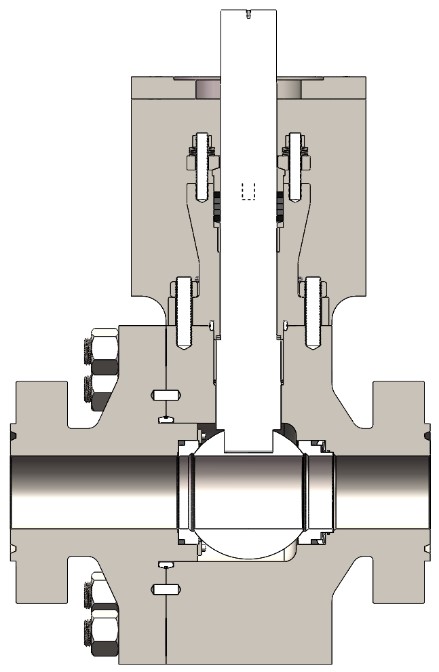
• High Temperature High Pressure Self Sealing Structure
The seal between the main body and the sub body adopts a high temperature high pressure self sealing metal gasket made of Inconel nickel base
alloy with gold plating on its surface. This metal gasket acts as an elastic seal. The force applied by the middle flange bolts on the gasket acts on the
wedge surface, causing radial deformation to generate an initial sealing specific pressure. As the internal medium pressure increases, the pressure on
the sealing surface also increases, achieving self energized sealing. Meanwhile, under alternating temperature and pressure, the elastic deformation
of the gasket produces preload, ensuring reliable sealing of the middle flange connection.
• Packing Live Load Structure
The stem packing chamber uses high temperature high pressure composite molded flexible graphite packing. The packing gland is preloaded and
locked with disc springs to prevent leakage caused by packing wear and alternating temperature and pressure. A positioning sleeve is installed in
the disc spring assembly to control the guidance and compression of the disc springs, extending the service life of the disc springs and packing.
• Stem Shoulder Double Thrust Bearing Structure
The double thrust bearing design allows the thrust bearings to slide during stem rotation, ensuring that the stem shoulder is not prone to seizure
under high temperature thermal expansion or medium coking. Meanwhile, an initial seal is formed among the valve body, thrust bearings, and stem,
effectively preventing medium from entering the upper packing area and protecting the packing sealing system from damage.
• Seat Structure
The upstream seat is loaded with disc springs at the rear to provide initial sealing specific pressure, ensuring close contact between the ball sealing
surface and the two seat sealing surfaces with uniform loading. This effectively compensates for the effects of thermal expansion of internal
components on sealing, even under high temperature and alternating temperature and pressure, while eliminating the possibility of seizure caused
by thermal expansion of internal parts. A dust seal is designed at the seat tail to effectively block catalyst particles and easily condensable media
from entering the spring chamber and causing spring failure.
The downstream seat serves as the primary sealing seat. The contact surfaces between the seat tail and the sub body are hardfaced with cemented
carbide and precision lapped in pairs to form metal to metal sealing. In addition, a high purity flexible graphite sealing ring is integrated into the
seat as a secondary seal, enhancing sealing reliability. The downstream seat is secured to the sub body with a retaining ring and hexagon socket
cap screws with tight fit. When reverse pressure occurs in the valve, the sealing surfaces between the seat and sub body do not separate to form
gaps, preventing catalyst and other media from entering the seat sealing system and affecting its performance. This structural design also improves
manufacturability in machining, surface hardening, and lapping of the seat sealing surfaces.
• Seat Sealing Surface Scraper Structure
Both upstream and downstream seats are equipped with scraper structures on their sealing surfaces. During valve opening and closing, the scrapers
automatically wipe the ball sealing surface to remove adhered substances and prevent catalyst particles from entering the seat sealing area and
impairing sealing performance.
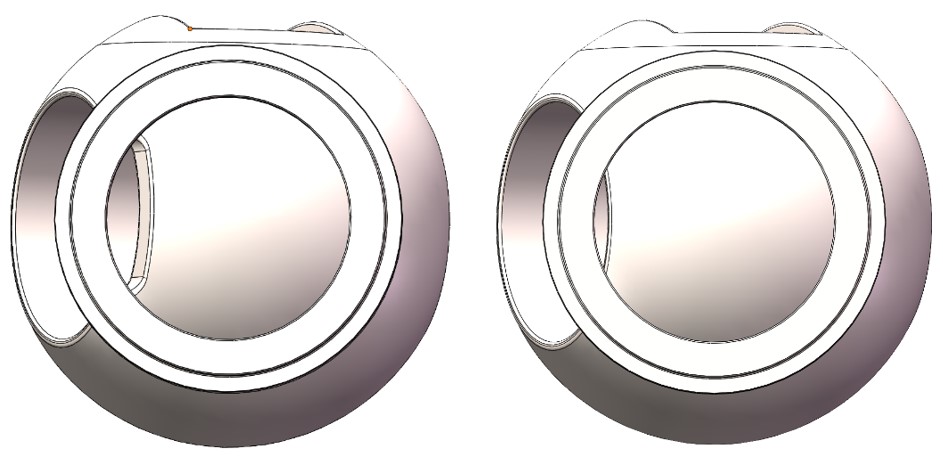
• Ball Anti Erosion Structure
At the instant of valve opening and closing, the flow area between the ball and seats near the ball port resembles an ellipse, which throttles the flow
in the pipeline. This causes a sudden increase in flow velocity at the elliptical constriction, resulting in severe erosion and wear to the ball port and
seats, leading to coating peeling and damage to the sealing pairs — especially pronounced in high pressure pipelines. Therefore, based on fluid
dynamic analysis, the ball port is designed with an asymmetric opening to increase the flow area at the instant of opening and closing, modify flow
patterns, diffuse the flow, and reduce flow velocity. This effectively mitigates erosion and wear on the ball port and seats caused by high velocity flow,
prolonging valve service life.
4. Selection of Sealing Pair Hardening Process
The selection of wear resistant materials and hardening processes for the ball and seat sealing surfaces is one of the most critical technologies
determining the wear resistance of metal seated ball valve, directly influencing service life and performance. Factors including operating pressure,
temperature, corrosion, medium hardness, and valve cycling frequency must be considered. In addition, the bonding strength between the wear
resistant material and the base material, coating thickness, hardness, scratch resistance, and base material hardness must also be evaluated.
Currently, two main sealing surface hardening technologies are commonly used: oxy acetylene flame spray welding and remelting, and High Velocity
Oxygen Fuel (HVOF) thermal spraying. Given the characteristics of ebullated bed residue hydrocracking units — high temperature, high pressure, gas
solid liquid three phase medium, high hardness catalyst particles, cyclic alternating temperature and pressure, and medium coking tendency —
metallurgical bonding between the cemented carbide coating and the base material is required to ensure high bonding strength and low porosity.
The bonding strength shall be no less than the yield strength of the base material. Suitable hardening processes include HVOF spraying + remelting,
spray welding + remelting, and laser cladding, to ensure excellent wear and erosion resistance of the coating.
Conclusion
The ebullated bed residue hydrocracking process involves gas solid liquid three phase mixed media. As one of the most important control components
in the unit, valves are required to withstand high temperature, high pressure, corrosion, erosion, alternating temperature and pressure, anti coking, zero
leakage, non seizure, and long service life. The FOKASI metal seated floating ball valve features full bore, large flow capacity, low flow resistance, simple
structure, reliable sealing, low seizure tendency, easy operation, and convenient maintenance. Combined with optimized structural design and specialized
sealing surface hardening technology, it has been widely applied in such units.
Contact: Jack Zhao
Phone: +86 158 2168 9399
E-mail: sales@fokasi.com
Whatsapp:+8615821689399
Add: Building 2,No.598,Guanghua Road,Minhang District,Shanghai,P.R.China